
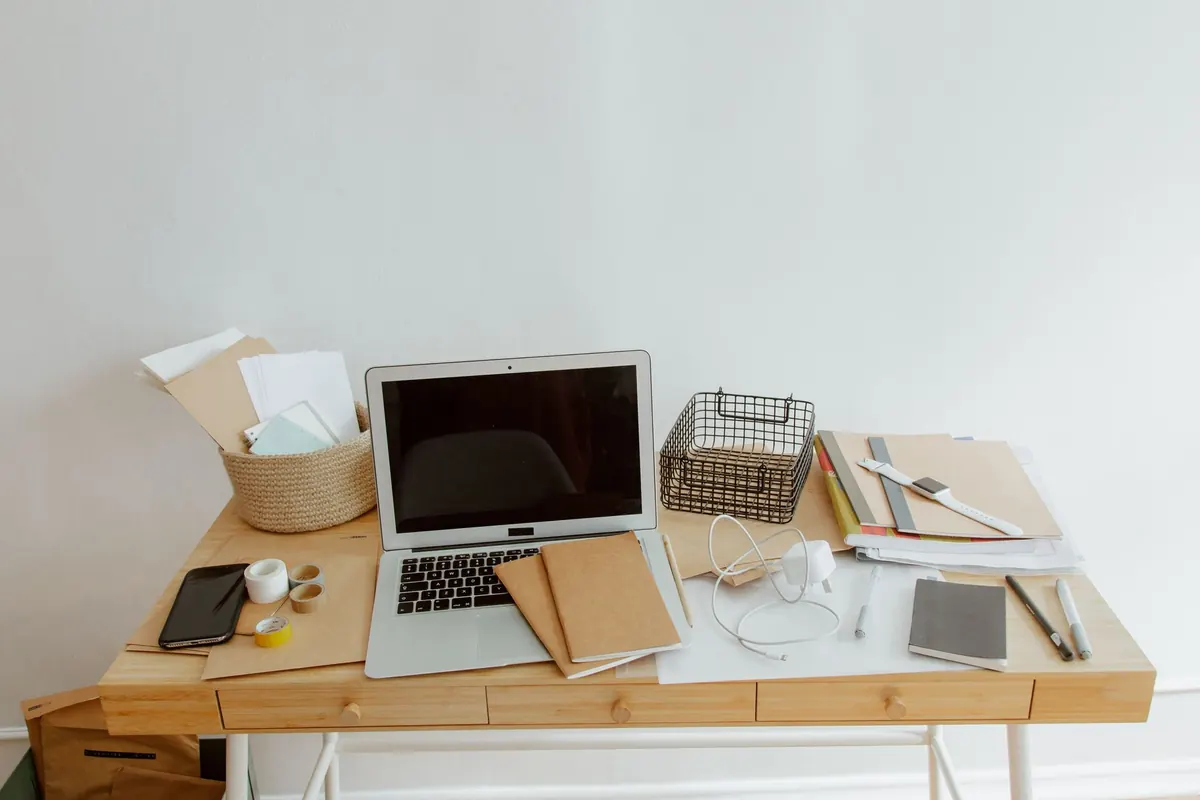
A desk is a promise: sit here and the writing will happen. Unfortunately, most desks are also a dumping ground for unopened post, three dead pens and a mug that has been there since Tuesday. Clutter isn't a moral failing — it's simply what happens when things arrive faster than they leave. The fix isn't a heroic clear-out twice a year, but a handful of small rules that keep the surface ready. Here's how to build a writing space that asks nothing of you except the work.
Start with the surface you actually write on
Take everything off the desk. Not tidied into stacks — off, onto the floor, into a box, into the next room. Wipe it down. Then put back only what you genuinely use during a writing session: the laptop or the paper, the pen you're writing with, a notebook, a glass of water, a lamp. That's usually it.
Everything else has to earn its place. A useful test: does this object serve the next ninety minutes of writing? If not, it lives somewhere else. What you're aiming for is a clear rectangle you can rest your forearms on, with nothing in your peripheral vision that invites a fiddle. Position the screen so the top of it sits around eye level, keep your wrists roughly straight, and put both feet flat on the floor. Small adjustments, but they buy you an hour of comfort.
Give stationery a home, not a heap
Writers accumulate pens the way kitchens accumulate plastic bags. Sorting them takes twenty minutes and lasts a year. Set aside a drawer or a lidded box and be honest about what you'll reach for.
- One pen you love, plus two spares, in a single pot or drawer — not a mug crammed with fourteen dried-out biros.
- A notebook for ideas and a notebook for the current project. Not five half-filled ones competing for your attention.
- Cables coiled, tied and labelled in one box, or clipped along the back leg of the desk so they stop snaking across the keyboard.
- A small lidded tray for things that wander in during the day: keys, coins, receipts, the stray hair grip.
- Everything else — refills, spare ink, offcuts, the novelty stapler — into a box that lives out of sight.
The point isn't minimalism for its own sake. It's that every object on a surface is something your eye has to dismiss before it can settle on the sentence you're trying to write.
Deal with paper before it becomes a pile
A pile is a decision postponed. Every sheet sitting on a desk represents something you haven't yet decided to do, file or bin, and that unresolved weight is surprisingly loud when you're trying to concentrate.
A pile is not storage. It's a stack of decisions you've agreed to make later.
So make the decision now, in one pass. Keep a single shallow tray for paper that needs action this week, a folder for reference material you actually consult, and a bin. Scan or photograph anything you're keeping purely for the information. If you can't remember why you kept a sheet, that's your answer.
Sort the room, not just the desk
The desk is only one zone. Think in rings: what's within arm's reach, what's within sight from your chair, and what's behind you.
Within arm's reach
Only the current session's tools. A drawer beside you can hold the refills, the stapler, the sticky notes. If you have to stand up to fetch something you use hourly, it's in the wrong place.
Within sight
This matters more than most people expect. If you look up and see a doorway, a kitchen counter or a television, part of your attention goes there and doesn't come back. Where you can, angle the desk to face a wall or a window with a plain view. Keep the shelf above the desk for books you genuinely use; a display of objects you've stopped noticing is just dust collection.
Light and sound
Daylight from the side is easier on the eyes than light from directly behind or in front of a screen. A decent lamp removes the late-afternoon squint. For noise, a pair of headphones and a consistent background sound does more for focus than any clever software. Keep the floor around the desk clear too — a bin is furniture, a stack of boxes is a job waiting to be done.
Reduce the interruptions you can control
Some interruptions arrive unbidden. Plenty are entirely self-inflicted.
Other people
Tell the household when you're writing and for how long. A closed door, headphones or a sticky note on the outside of it works as shorthand once everyone knows the code. Agree that anything non-urgent waits until you surface. Most people are far more willing to respect a stated boundary than a vague air of irritation.
The phone
Face down on the desk isn't enough — you'll still see it light up. Put it in another room, or at least in a drawer you can't reach without standing. Turn off notifications for everything except calls you'd genuinely want to take, close email and messaging, and work in one browser window. If you need the internet for research, note the questions you want answered first, look them up in a single pass, then close the tab.
Your own restlessness
When a stray thought arrives — reply to the plumber, check that word — write it on a scrap of paper and carry on. The scrap is a holding pen, not a to-do list, and you can clear it at the end of the session.
A five-minute reset after every session
The tidiest desks in the world fall apart by Thursday unless there's a routine. Do this before you stand up:
- Clear the surface back to the basics: machine, lamp, water, one pen.
- Put pens in the pot and close the notebook. Close the laptop lid too.
- File or bin the paper. Nothing goes into a "deal with it later" stack.
- Empty the mug, wipe the crumbs, push the chair in.
- Write the first task for tomorrow at the top of the page or on a sticky note.
Five minutes now buys you a clean start later. Tomorrow's session begins with the work instead of with tidying.
Make the space boring, and the work interesting
A writing desk doesn't need to look like a magazine photograph. It needs to be predictable. The same clear surface, the same pen in the same place, the same silence or soundtrack, so that sitting down becomes the cue rather than the hurdle. Try one surface tonight: empty it, put three things back, and notice how the first ten minutes of writing feel tomorrow morning. Then do it again the next day, and let the small rules carry the rest.
Photo: Ron Lach / Pexels